Tell someone from Boston you walked the Freedom Trail and ate at Quincy Market, but skipped Harvard Square and never saw the swan boats.
Then, watch what happens.
I dare you.
They’ll look at you like you insulted their mother. Then they’ll give you eight more of their favorite things to do in Boston, MA, you have to do next time.
This is inevitable. Everyone has a Boston they’re loyal to.
I should admit my bias up front. Most of my family has lived in Boston at one point or another. That list includes cousins and my brother, who’s still up there with my niece and nephew. I was the one who moved to Charleston instead, mostly to be a family rebel. So I know the city well without ever quite living in it.
Close enough to have opinions.
Far enough not to be insufferable about them.
Here’s the thing I’ve learned from all those visits to what I consider the capital of New England. Boston is huge, and it’s far more pleasurable not trying to see all of it in one go.
Ready to discover the best things to do in Boston MA? Let’s get into it:
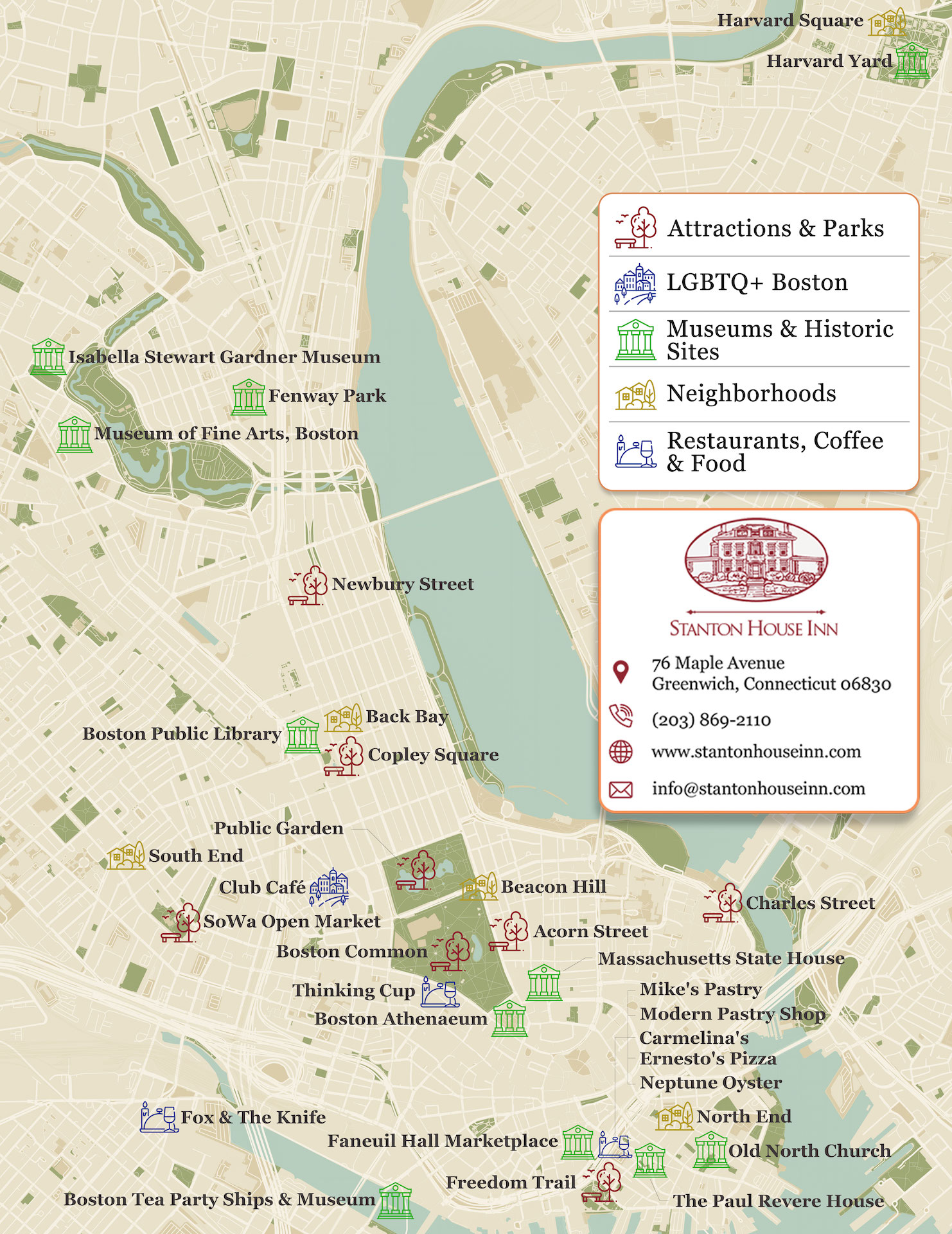 Map design by Stanton House Inn with elements from Flaticon

Why Boston is Better as a Slower First Visit

Boston is compact in a way that fools people. A surprising number of the central neighborhoods sit within a half-hour walk of each other. For a city this old and dense, that’s dangerous information.
So people look at the map and think: Beacon Hill, the Common, the North End, Back Bay, maybe Fenway. Sure. Why not all of it?
Then their feet file a complaint.
Plenty of first-timers speed-march the Freedom Trail, eat a cannoli, photograph a brownstone, and leave. They’ve seen the highlight reel. They haven’t seen Boston.
So when people ask me what the best things to do in Boston are, my answer is a question:
How much time do you actually have?
Pick one walkable home base in a good location, and experience whatever sits within easy reach of it. Boston is like New York. You can always come back.
The famous stuff is famous for a reason. See some of it. Take the photos. Just don’t confuse the photo roll with the trip.
This guide skips the full inventory. It focuses on the handful of neighborhoods and experiences that give you a real first read on the city. And all without sending you home needing a vacation from your vacation.
The Best Things to do in Boston, MA (ie: Where to Focus Your Time)

A weekend is enough to do a few neighborhoods well. Here are the ones worth your hours, roughly in order, and what each is actually for.
Beacon Hill: The One You Can’t Skip
My favorite Boston trip was a summer visit for my brother’s wedding. I stayed on a friend’s couch in Beacon Hill, Prashanth from my Peace Corps days, and the part I remember best wasn’t a landmark at all. It was walking the neighborhood with someone who lived there, on a good-weather afternoon, looking at old houses.
That’s Beacon Hill. It’s the Boston people picture before they’ve ever been to Boston:
- Brick sidewalks
- Old rowhouses
- Gas-style lamps
- And cobblestones that seem determined to humble every suitcase wheel in New England

It’s the neighborhood most likely to make a first-timer stop and think, this is the Boston I came for.
A few practical notes:
- Acorn Street is one of the most photographed streets in America. It’s also a private cobblestone road, so take your picture from the corner instead of walking down it.
- Charles Street is the main shopping spine. Locally owned boutiques, antique shops, cafés. Worth a stroll even if you buy nothing.
- The Massachusetts State House, gold dome and all, crowns the top of the hill. Free guided tours run weekdays, roughly 10am to 3:30pm, closed weekends.
- The Boston Athenaeum on Beacon Street is a quiet five-floor independent library from 1807. It’s full of rare books and historic art. If you’re the kind of person who ducks into old libraries, do so. If you’re not, walk past it guilt-free.
Give it a half day at least. On a tight weekend, Beacon Hill plus the Common plus the Public Garden is one of your two core half-days, with Back Bay or the South End as the other. Go on a weekday morning if you can, because weekend afternoons bring the tour groups.
One caveat: those cobblestones are hard going if you have any trouble with uneven ground.
There’s also a layer here most guides skip. The north slope, near Joy Street, holds deep LGBTQ+ history going back to the late 19th century, from early queer publishing to AIDS-era protests. The West End Museum runs a free virtual walking tour of it, if you’re interested.
South End: The Neighborhood Most Visitors Miss

When Prashanth walked me around that weekend, the part that stuck with me most was a cluster of streets full of converted brownstones. Residential up top, restaurants and boutiques and little shops tucked into the ground and basement floors. The Boston cousin of a New York brownstone block.
I thought it was the coolest thing.
That was the South End, by Boston Commons. If I’m somehow wrong, a Bostonian will correct me within twelve minutes of this going live. That’s part of the local service economy.
That mix of townhouses and ground-floor restaurants is classic South End. And it’s the neighborhood most first-timers never make it to. Bigger than Beacon Hill, full of Victorian brownstones, and home to the densest run of good restaurants in the city.
It’s also Boston’s most established queer neighborhood, with roots going back to the 1960s and ’70s. Club Café on Columbus Avenue has anchored the gay social scene here for decades. The SoWa district, South of Washington, runs an open-air market most Sundays from roughly early May into mid-November. It’s got local vendors, food trucks, a beer garden, artist studios. Free to wander, though dates shift year to year, so check the SoWa site before you plan a Sunday around it.
A SoWa market, brunch, and a slow neighborhood walk is one of the best half-days in the city. This is where a lot of locals spend their weekends.
North End: Go for a Meal, Not an All-Day Plan

The North End is Boston’s oldest neighborhood and its Little Italy. It’s dense, old, and chock a block with restaurants, pastry shops, and buildings that have seen a few winters. It also hosts Freedom Trail sites like Old North Church and Paul Revere’s House. Since you’ll naturally pass through, don’t mentally double-book those into a separate day.
Here’s the honest read:
There isn’t much to do in the North End beyond eating, walking, and admiring the buildings. That’s not an insult. The above three things are pretty much all I do on a typical day trip.
It just means you shouldn’t try to stretch it into a whole day. It’s a dinner neighborhood. Arrive hungry, wander a bit, eat well, walk off dessert on the streets afterward, and call that a win.
On the cannoli question, since someone always asks:
Mike’s Pastry has the famous line, and Modern Pastry is the local pick for people who’d rather not stand in it. Both are good. My rule: don’t wait more than fifteen minutes for a cannoli (or anything else, for that matter).
It’s pastry, not a papal audience.
One timing trap. Saturday afternoon is the worst possible time here, with all the narrow streets and crushing crowds. Go on a weekday evening or early Sunday instead.
Back Bay and Newbury Street: Beautiful, Worth the Loop

Newbury Street runs eight blocks of elegant brownstones from the Public Garden out to Massachusetts Avenue. The eastern end near the garden is the luxury-brand stretch. It gets more interesting and less corporate the farther west you walk. So start at the Arlington Street end and head away from the garden.
Locals will tell you the same.
If you’re more shopper than museum person, this is the part of town in which to meander.
The reason to come, though, isn’t the shopping. It’s the Boston Public Library at Copley Square. People hear “library” and assume they’re getting homework. You are not.
It’s free, it has Sargent murals and a courtyard café. Plus, it’s the kind of building that makes you wonder why modern architecture gave up trying.
Give Back Bay two or three hours, pair it with the Public Garden, and you’ve got a full morning on foot.
Cambridge and Harvard Square: Only If You Go Right

Cambridge sits across the Charles River, a quick Red Line ride away. Harvard Yard is free to walk through, and the square has bookshops and long-established coffeehouses and street performers. You also can eat very well across the river. A lot of Boston’s best restaurants are technically in Cambridge.
Harvard Square underwhelms people who show up expecting a grand reveal, though. Treat it as a wander. Bookstores, coffee, the Yard, then get dinner nearby.
Here’s how Prashanth showed-off Cambridge. Don’t wedge it into a day that already has the North End and Fenway in it, or you’ll mostly remember the subway. It’s worth its own half-day, ideally on day two of a longer stay. And if you’re only in town 48 hours and you’re not a campus-and-bookstore person, skip it this time.
It ain’t going anywhere.
The Freedom Trail: Worth Doing, Not as an Endurance Test

The Freedom Trail is a 2.5-mile path linking 16 historic sites, marked by a red line set right into the sidewalk. That red line is the most useful thing about it. It means you can do the trail in pieces, at your own pace, with no guide and no map.
Most people don’t realize that and treat it as a single march from Boston Common to Bunker Hill. Don’t. The full thing involves real hills, and the northern stretch toward Charlestown demands more of your back legs. Worth it for history nerds. Not for everyone, of course.
Here’s how I’d do it:
Walk the southern half, Boston Common up through the Faneuil Hall area, as a standalone morning of about two hours if you step into a site or two. Then either take the harbor ferry back instead of retracing your steps, or save the northern sites for a separate North End morning.
Same trail, half the slog.

If you want real history instead of a brisk overview, the local nonprofit Boston By Foot runs expert-led walking tours. History buffs are fans (like this writer). Pricing and departure times shift seasonally, so confirm before you go.
While we’re here:
Faneuil Hall is free and fine to see, but the Quincy Market food court inside it is a tourist trap with little local character. Walk through, use the restrooms if you need them, then go eat in the North End or the South End instead.
What about Museums in Boston?

Let me split the museum question two ways, because the Tea Party Museum isn’t really the same kind of decision as the other two.
If you only have one museum slot: Gardner vs. MFA
The Isabella Stewart Gardner Museum was the home of an eccentric collector. The eponymous owner left her art to Boston on the condition that it stay arranged exactly as she placed it. The Venetian-style courtyard is a space you don’t forget. It’s also the site of the still-unsolved 1990 heist, and the empty frames hang where the stolen paintings used to be.
The Museum of Fine Arts is one of the largest art museums in the country. Egyptian and Nubian collections, Asian art, American decorative arts, the full sweep. It’s superb, and you’ll need three or four unhurried hours you won’t have on a weekend, even a long one.
For a first-time visitor with one slot, go to the Gardner. There’s nothing else like it anywhere, and that’s the whole point of a museum on a short trip. The MFA is wonderful, but it has equivalents in other cities. Save it for a return visit.
And don’t try to do both in one day. They’re a few minutes apart on foot and a world apart on energy.
If you want one strong interactive experience: the Tea Party Museum

The Boston Tea Party Ships & Museum is a different animal. Live actors, replica 18th-century ships, the chance to throw tea into the harbor. It is not quiet. That’s the point. My parents brought me as a kid. And it’s certainly engaging, especially for first-timers.
It tends to sell out on busy weekends, so book ahead and go mid-morning when the first tours have the most energy. It’s best with kids or theatrically inclined adults. If you’d rather put that money toward a quiet museum or a good dinner, no shame.
Boston Common and the Public Garden

This is the part of my Beacon Hill trip I remember most clearly. And it wasn’t anything remarkable, in the grand scheme of things:
Just walking the Common with a local on a good day.
Boston Common is America’s oldest public park, and the Public Garden next door is the country’s first public botanical garden. Together they’re the easiest, most central half-hour you’ll spend, and they’re a natural pairing with a Beacon Hill or Back Bay morning.
It’s also the part of Boston where everyone (even first-timers) slows down. Ducks, tulips, old trees, swan boats. The whole thing is almost offensively pretty in late spring, when the flowering trees come in, and again in fall.
The swan boats are charming. Pedal-powered pontoons run by the same family since 1877, a few dollars a ride. They typically run mid-April into early or mid-September, so if you’re visiting later in fall, better luck next time. Ride one, photograph the Make Way for Ducklings sculpture, and move on with your day. It’s a fifteen-minute delight, not a destination.
On a cold or rainy day, this is the easiest thing on your list to drop.
Food, Coffee, and Where to Actually Eat

I’ll keep this short, because Boston food deserves its own guide and this isn’t it. Boston food opinions also get tribal fast, and I’m not trying to start a pastry war before lunch.
If you only care about one memorable dinner, pick the South End or Cambridge over the North End. The North End is for atmosphere and a great meal in a great setting. The best food in the city lives across the river or below Washington Street.
A few decisions that matter more than a long list:
- For Italian and atmosphere: the North End, but make a reservation. Carmelina’s, Ernesto’s, or Neptune Oyster for seafood, rather than wandering in blind on a weekend night.
- For your best dinner: the South End and Cambridge. A number of the South End spots are queer-owned or queer-friendly. Fox & the Knife is among them, and BostonQueers keeps a directory if that’s how you travel.
- For morning coffee: Tatte makes a reliable Beacon Hill or Back Bay start. Thinking Cup, near the Public Garden end of Newbury, is another reliable spot.
- For casual grazing: the SoWa market on a Sunday beats most sit-down lunches you could plan.
The one rule I’d put in bold: skip the Quincy Market food court. The North End is right there.
Getting Around: Don’t Drive

I refuse to drive in Boston, and I’d tell you to do the same.
I won’t drive in New York either, but at least Manhattan’s streets follow some logic.
Boston’s roads began as cow paths and appear to have kept the management structure. Add the local driving style, which earned the residents a nickname I won’t print here, and you get where this is going.
Find a place to leave the car if you’re stopping in on a New England road trip, and don’t touch it again until you go home. Or, better yet, don’t bring one at all.
The T handles almost everything a visitor needs. Tap a contactless card or your phone (no need to buy a physical CharlieCard first) and learn the one rule that matters. If your destination is under fifteen minutes on foot, walk. The central neighborhoods really are that close together.
(Fares change. Check current rates at mbta.com before you go.)
When to Go

Fall is the easy answer. Mid-September into mid-October, when the weather turns crisp, the foliage starts, and the summer crowds thin out. Late spring is the strong runner-up. Warmer, flowers in the Public Garden, fewer people than summer.
Summer is hot, humid, and crowded (though I loved my visit with Prashanth). Locals flee to Maine or Cape Cod. That said, the North End’s August feasts are worth planning around if that’s your kind of thing. Winter is cold and the Beacon Hill cobblestones can ice over, so it’s not my pick for a first visit.
One specific heads-up for 2026. Boston hosts seven FIFA World Cup matches between June 13 and July 9. Hotel prices and crowds during that window will be something to behold. Plan around it, or plan for it, but don’t get caught off guard.
If You Have More Time

Two more Boston MA attractions earn a spot on a longer stay, not a first weekend:
The Boston Harbor Islands are a treat on a warm, clear day. A 45-minute public ferry out to Georges Island and its Civil War fort. Or pass Castle Island to get to Spectacle Island for beaches and skyline views. The ferries run roughly June through September. If you don’t have at least four or five hours door to door, skip it this trip.
Fenway Park is the oldest active ballpark in the majors, and it’s worth seeing whether you follow baseball or not. Take the roughly hour-long tour rather than fighting for game tickets. Unless you’re a real fan, of course. The tour costs less than the cheap seats anyway, and timing shifts on game days, so check the schedule. Pair it with the Gardner for a Fenway-Kenmore half-day.
From Greenwich to Boston: The Corridor Route

A quick word on where Boston fits in a bigger trip, since it’s a question I get at the breakfast table in Greenwich.
Boston sits at the northern end of the corridor. From Greenwich it’s usually about three to three-and-a-half hours by car. That’s assuming traffic behaves itself, which is a bold assumption. One of my sisters could do it in three, but she’s famous for being a lead foot.
If you’re coming from New York, Greenwich makes an easy first or last stop, and you get the quiet part of the trip before the full-throttle part. The same train line that runs NYC to Boston serves Greenwich too, if you’d rather not drive at all.
And if you’re driving north, stop in New Haven for pizza. Everyone and their mother talks about it for a reason.
Boston is where the trip speeds up. Greenwich is where you relax, before or after.
That’s how I’d plan a trip to Boston, Massachusetts, anyway.