Skip to content


 We get an offer to buy Stanton House Inn about once a week. Some weeks, two or more.
I get it. Someone looks at comparable sales near New York City, divides the price by the number of rooms, and lands on a figure. It’s defensible. As far as the math goes, it’s even right.
The trouble is that the figure describes a building. It says nothing about the practice.
They see the property. They do not see the practice. That’s most of why so many hotels feel the same now.
I don’t think this is only my problem. I think it explains the hotel you stayed in last month. The one you liked fine yet can no longer picture.
If you don’t know who I am, my name is Colin Pearson. Fourth-generation innkeeper here in Greenwich, Connecticut. I grew up in this house, left, and came back. That last part is messier than three words make it sound.
The video was the short version. This is the part that didn’t fit.
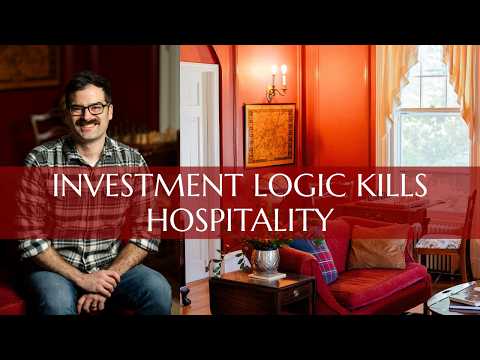
The math is right. It’s also blind.
Start with how a place like this gets priced, because the pricing is where the blindness begins.
Buyers reach first for a number called price per key. Total sale price divided by the number of rooms. I looked it up to be sure: in strong markets it runs somewhere between eighty thousand and two hundred thousand dollars a room, higher in the big cities. A twenty-one-room inn becomes a multiplication problem from there.
There are fancier tools. Cap rates. Discounted cash flow. Ten-year models with a terminal value at the end, which is a formal way of asking what the next buyer will pay to take it off your hands later.
None of it is wrong. It’s careful, even. But every one of those tools prices the income the building throws off, then quietly assumes that income keeps arriving after the person producing it is gone.
That’s the blind spot. The math can measure the output. It can’t see what makes the output.
Why so many hotels feel the same
 Here’s the part people get backwards. The reason so many hotels feel interchangeable is not laziness. It is precision.
Big hotel brands write standards for everything. Thread count. Lobby lighting. Where the signage sits. How a front desk agent phrases a greeting in Dallas so it matches the one in Denver. There are audits. There are checklists. Consistency isn’t an accident they failed to prevent. It’s the product they set out to build.
And for a lot of travelers, that’s exactly right. You want the room in a strange city to hold no surprises. Familiar is the whole point.
The result is a specific kind of sameness. You land somewhere you’ve never been. Same lobby scent. Same playlist. Same little bottles in the same kind of bathroom. You could be in Boston or Berlin. You flew five thousand miles and nothing moved.
You can buy the signals of a place without buying the thing that made the place worth visiting. Warm lighting, raw linen, a candle, a record player in the corner. All of it is for sale. None of it needs the history that produced it.
I watch a smaller version of this on Greenwich Avenue. A company opens a store here because it wants to say it has a Greenwich address. It looks good in a pitch deck. And the store is lovely, I mean that. It’s also identical to their store in Fort Lauderdale. Is that particular shop special? No. Nobody who opened it thought it would be. Special wasn’t in the brief.
Most hotel brands are logos
Seth Godin has a thought experiment I keep coming back to.
If Nike announced tomorrow that it was opening a hotel, you could describe it. The feel. The pace. What it would care about. You have never stayed in a Nike hotel. It doesn’t exist. You could still sketch it right now.
Now flip it. If a big hotel company announced it was launching a shoe, you’d have no idea what the shoe was. None.
Godin’s line: most hotel companies don’t have a brand. They have a logo. A real brand has a point of view, and you can feel it even when it shows up somewhere new.
So here’s the test I set for us. If Stanton House Inn wrote a travel guide, would you already know the kind of place we’d send you? And the kind we’d skip?
I think you would. But only because of something that took years to build and shows up on no balance sheet anywhere.
What an offer leaves out
When someone makes an offer on a great bed and breakfast (like this place), here’s what the number can’t include.

Judgment
Not rules. Not a training binder. Judgment.
The kind that comes from caring about one house for a long time. What to renovate and what to leave be. Sometimes that means a new bathroom. Sometimes it means leaving the old fireplace exactly where it is and building the whole room around it. When to follow a policy, and when to quietly take one apart on a guest’s behalf.
You can write down the values behind that judgment. You can’t write down the judgment. It gets earned, slowly, and it doesn’t transfer with the keys.
Care
There’s a real difference between processing a guest and hosting one.
Processing sounds like this. You’re checked in. Here’s your key. Breakfast is at eight. Here’s the Wi-Fi.
Hosting is different. I know why you’re here. I thought about your stay before you arrived. I’m paying attention the way a good host at a dinner party pays attention. Not hovering. Just aware of how your time is going.
Danny Meyer put the same line better than I can. Service is the technical part, done right. Hospitality is whether any of it made you feel like a person. The first you can standardize. The second you can’t. It’s a skill, it takes years, and you can’t add it to a renovation budget.
Trust built before arrival
Some guests know me before they walk in. In a one-directional way. They’ve watched the videos. They’ve read the newsletters. They’ve heard me talk about this house for months.
They arrive already trusting a version of me they’ve never met. That trust is real, it matters, and it’s worth close to nothing to a buyer.
Accountants have a dry name for this kind of value. They call it personal goodwill: worth that’s tied to a person, not the company. If the person goes, it goes with them. Guests feel that shift when an inn changes hands, even if they can’t say what changed.
The videos and the emails aren’t the asset. They’re the paper trail of a point of view. A new owner could keep posting them. Meaning them is a different job.
Stewardship, and the order it came in
 The best things I know about running this place did not come from a strategy session. They came from things going wrong. Renovations that dragged. A guest who told me the truth when a smile would have been easier. A system that failed at the worst possible hour. That’s where the learning lives. In the rubble. Not the brainstorm.
There’s a hotel in Zurich, the Baur au Lac, that has stayed in one family’s hands for more than a century and a half. What stuck with me wasn’t the grand-hotel part. It was the time horizon. One generation hands it to the next with the understanding that you make decisions you can live with for a long while, because you’re the one who has to live with them.
That feels familiar. Old houses teach the same lesson whether you want it or not. Cut a corner on a repair and it tells on you eventually. The cheap fix fails at the worst time, and there you are doing it over, properly this time.
And then there’s the sequence. That’s the part that matters.
Most people in this industry make money somewhere else first, then buy their way into hospitality. That produces a certain kind of business. Rational. Well-run. Well-funded. What it doesn’t produce is an emotional connection to the work, because the connection was never the way in.
We did it backwards. The connection came first. The business grew out of it slowly, and often not on purpose.
My own detour ran through farming in Western Massachusetts, of all things. I grew good stuff. I couldn’t sell it fast enough. I had a product people wanted and no idea how to reach them. The lesson was blunt: it doesn’t matter how good a thing is if nobody knows it’s there. Marketing wasn’t a nice-to-have. It was survival. That’s what pulled me into it, and eventually back here, carrying tools the generations before me never needed.
We grow up in this house. We leave. We come back. I say “we” like it’s a rule. It isn’t. It’s just what keeps happening in my family.
Guests feel the output before they have words for it
 Guests do not read brand strategy. Obviously. Nobody is thinking about investment logic on their way through the front door.
But they feel the output. You can watch it happen.
Someone comes in from the parking lot after an hour on the train, or three hours on I-95, or a week that ran longer than they planned. And somewhere between the door and the front desk, before anyone has said a word, their shoulders drop. They take a breath. Their brain has already decided to relax, without asking them first.
That’s not the playlist. That’s not a candle. That’s what it feels like to walk into a place built by people who care whether you have a good time here.
Psychologists have a name for the pull people feel toward a certain place. They call it place attachment. The research keeps finding the same thing: the people matter more than the scenery.
We keep the thank-you notes people send. One came last year typed on an actual typewriter, from someone who had driven up from Brooklyn and stayed a week. They wrote that it felt like staying in someone’s home. That’s the goal, exactly. But the typewriter was the part that got me. Somebody went home, found a typewriter, and used it.
And then there are the guests who bring records. Not to take home. To leave. They add an album to the collection so it’s waiting for them next time, and so the next person can hear what they liked. A guest who does that isn’t consuming the place. They’re joining it.
That’s not normal hotel behavior. Which is the point.
What I’m not saying
Chains are not bad. Investing in hospitality is not a crime. You can have a fine, comfortable stay at a hundred properties built entirely on the logic I’ve been describing.
The argument is narrower than that. If a lot of places feel the same, it’s because they were built from the same inputs. Investment logic, applied well, produces consistent results. The system is working exactly as designed.
I just want a different result.
You can buy the building
So yes. Someone can buy the Seaman-Brush House, which is the name on the old deed. They can buy the fireplaces and the rooms and the address. They can buy the floors that announce every person heading upstairs.
They can’t buy why my family stayed.
You can buy a building. You cannot buy what makes it matter. That’s most of why hotels feel the same. It’s also why a few of them don’t.
If you’ve ever stayed somewhere that felt like itself and couldn’t say why, you were being hosted, not processed.
If you want the house’s own story, start there.