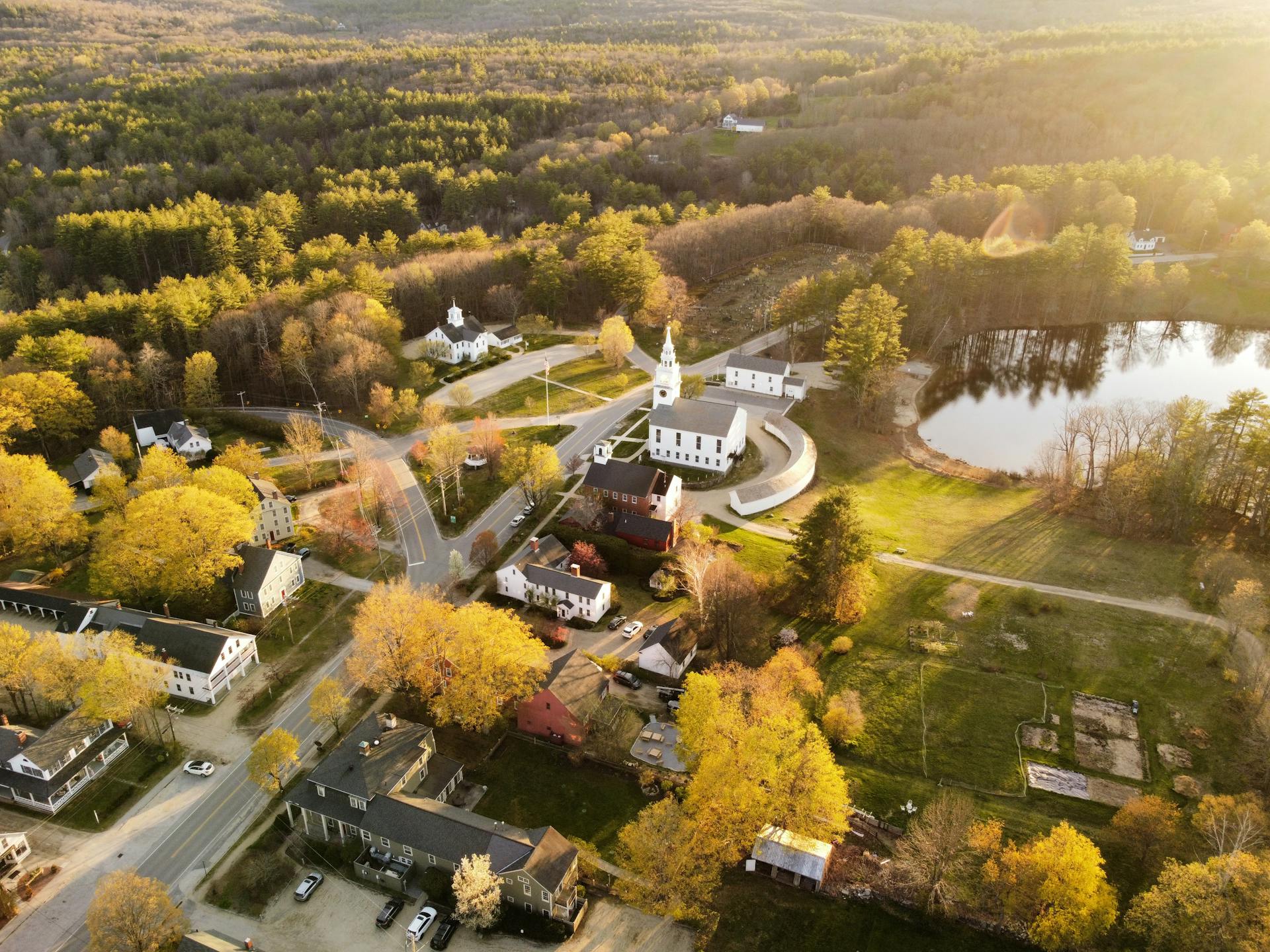


New England history doesn’t reward rushing.
The historic New England sites that linger aren’t the most prominent. They’re the ones where the past still governs how people live now, where:
- Old houses are still homes
- Town greens still anchor everyday life
- And history isn’t roped-off behind velvet ropes
This guide is for travelers who care about that kind of history. The kind of New England heritage you sense underfoot. It’s not the kind you’re herded through on a tour.
We’re based in Greenwich, Connecticut, an ideal place to start. It’s the first town in New England on the commuter rail from New York City. And founded in 1640, it’s one of the oldest towns in Connecticut. Convenient and quite consequential in its own right.
I live and work in a historic house here, built in the 1840s. There are maps on the walls showing Revolutionary-era skirmishes that transpired in and around town. That was back when Greenwich sat on the border between British-held New York and rebel New England. Waking up in a spot that has seen centuries of ordinary life reframes everything you see that day.
One planning note up front, as it’s essential for these New England road trips to historic sites:
If something takes more than about 2.5 hours to reach from Greenwich, it’s better kept for an overnight. Four hours of driving on East Coast road trips is not the same as four hours out West. History is better appreciated when you’re rested.
Ready to discover the best New England historic sites? Let’s get into it:
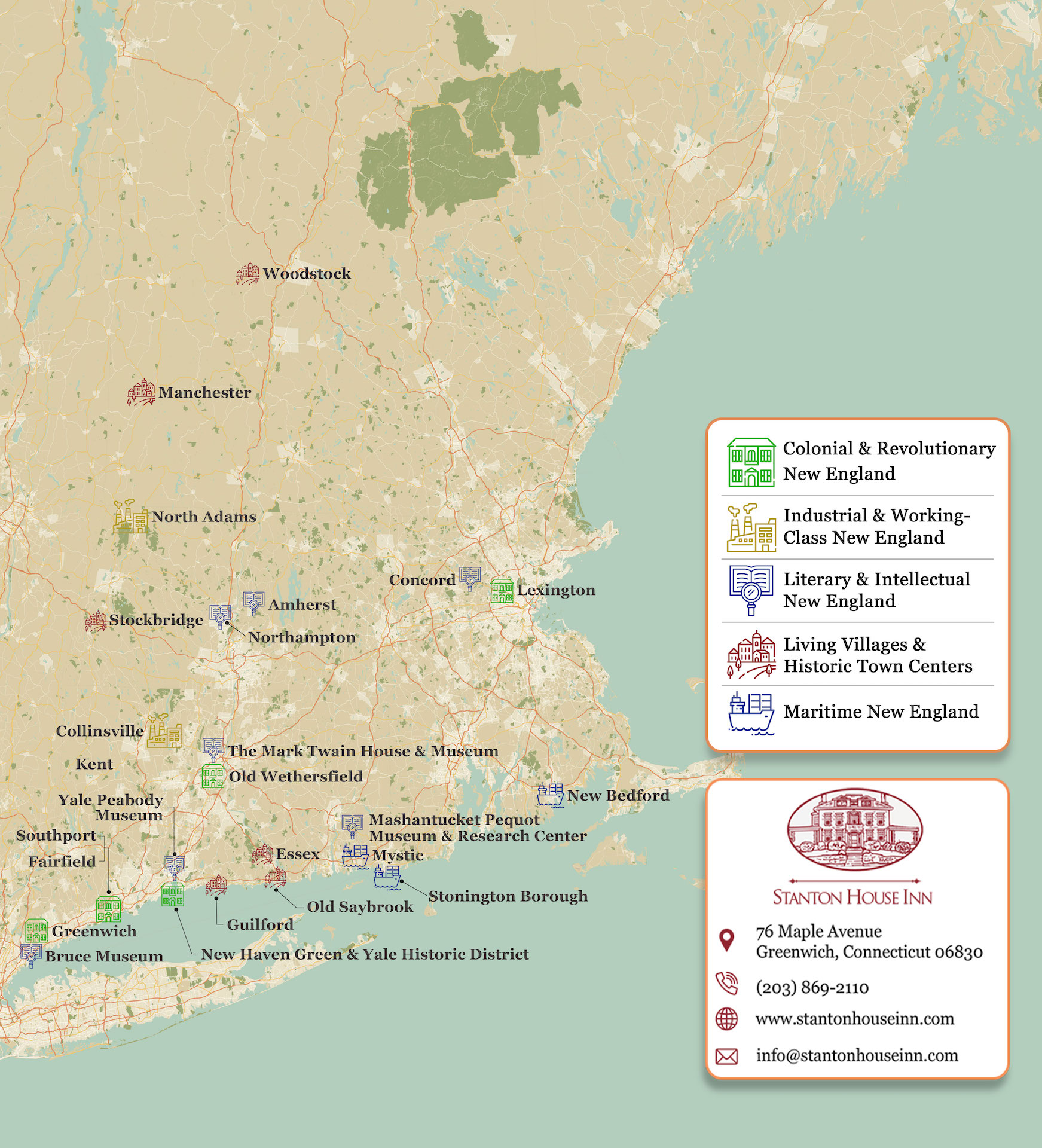 Map design by Stanton House Inn with elements from Flaticon

New England Historic Sites

What follows isn’t a checklist. It’s a curated set of historic sites that still feel real (and reward slowing down).
Colonial & Revolutionary New England

Drive times below are from Greenwich. A“half-day” means you can go, wander, and return without rushing.
These are places where colonial and Revolutionary history isn’t static. It’s embedded in neighborhoods, street layouts, and the way towns operate.
Old Wethersfield, Connecticut
Old Wethersfield is one of the best places in New England to understand how a colonial town resembled.
This isn’t a reenactment village. It’s a lived-in town where some of the oldest houses in the state line quiet streets, juxtaposed so you grasp early settlement patterns.
New Haven Green & Yale Historic District, Connecticut

New Haven’s Green is one of the purest examples of layered New England history.
You can stand in one place and see how:
- Religious
- Civic
- And educational priorities
Overlapped and evolved over time. Yale’s historic buildings aren’t isolated; they spill into the city and remain part of daily life.
Fairfield County’s Coastal Colonial Towns
Along Long Island Sound, colonial history shows up in quieter, more domestic ways.
These towns grew around farming, trade, and early coastal routes. Greenwich, Fairfield, and Southport each keep a different slice of that older pattern:
- Harbor
- Green
- And main street
All without needing to announce it.
Lexington & Concord, Massachusetts

Lexington and Concord are foundational American Revolution sites.
And if you care about that period, they’re worth seeing, of course. The experience here hinges on timing and expectations. That said, the battlefields are school-like during peak hours, especially in high summer.
Early mornings, shoulder seasons, or visits that focus on town centers are far more gratifying. Standing at the North Bridge, where the “shot heard round the world” entered the history books, feels quite different when you’re not wedged among guided tour groups.

Many visitors also pair Lexington and Concord with the historic items on Boston’s list of attractions:
- Freedom Trail
- The Old North Church
- Faneuil Hall
- And Boston Harbor
Classic stops with pews, plaques, and an inevitable gift shop. But I find Concord’s streets and greens do as much work in a far more tranquil setting.
You’ll see Concord again later, from a literary angle. It rewards more than one kind of visit, I’d say.
Closer to Home: Greenwich as the Front Door to New England History

Greenwich is often mistaken for something it isn’t.
Yes, it’s affluent. But it was also a border town during the Revolutionary War, sitting between British-held New York and rebel New England. Skirmishes and raids happened here, along roads people still walk today.
Like many seventeenth-century settlements along the coast, Greenwich spent decades as a border town, in fact. And there were regular questions on who owned what:
- New York
- New England
- England
- Even the Netherlands
All left traces in land claims and old maps.
That layered history is part of what makes Greenwich a natural starting point. You’re already standing on historic ground before you head northwards.
Maritime New England

Drive times below are from Greenwich; “half-day” means you can go, wander, and return without rushing.
Mystic, Connecticut
Whenever I have first-time visitors to Connecticut, I take them to Mystic. That’s not because it’s undiscovered, obviously. Rather, it’s a charming-as-all-get-up tourist trap that feels like classic Connecticut in one walkable town.
The historic streets, the drawbridge, and the riverfront are free to wander. You can stroll, eat well, watch boats pass, and leave feeling like you experienced the place.
Mystic Seaport is a different beast entirely. It’s a large, impressive maritime museum, perfect for quiet weekdays or in shoulder seasons. Especially so if you already know you enjoy shipbuilding and maritime craft. That said, it’s expensive, and peak summer weekends can add pressure to “get your money’s worth.”
That’s why I usually send people to the town first, and Mystic Seaport only if they’re already in love with ships.
Stonington Borough, Connecticut

If Mystic feels busy, Stonington feels settled, albeit just as quaint.
This compact harbor village has one of the most intact historic cores on the Connecticut coast. Houses, churches, and streets still line the water the way they always have. And much of the town feels genuinely residential, not staged.
New Bedford, Massachusetts

New Bedford tells a more serious maritime story.
As one of the most important whaling ports in the world, its history is tied to industry, labor, and global trade. The city doesn’t try to pretty up that story, and that honesty is part of what makes it compelling.
If maritime history is your thing, keep following this thread into Rhode Island and New Hampshire. They’ll take you through working:
- Ports
- Lighthouses
- And old harbors
That still feel like part of a wider network of New England heritage, not set pieces.

Don’t miss:
Especially, if that’s your jam.
Industrial & Working-Class New England

Most mill towns, I’d recommend you see from the car window. You can see the river, the brick, the old factory walls, and you get the story without needing to stop.
Collinsville is the exception that’s worth getting out.
Collinsville, Connecticut
Collinsville never got scrubbed into a set piece.
The mills are still there. The river still cuts through town. And the place never pretended otherwise.
This is where I go when I want old brick, a river, and enough antique stores to while away an afternoon.
North Adams, Massachusetts
North Adams is what happens when a whole mill complex gets refurbished, rather than razed.
The vast brick factories that once powered a company town now house MASS MoCA. It’s now one of the country’s most interesting art museums. Here contemporary New England art and large-scale installations fill and add to old industrial spaces.
You still feel the industrial bones everywhere: long walls, smokestacks, rail lines, and the narrow valley that shaped the town.
This is without question an overnight destination from Greenwich. And all the better for it! I’d lump into a wider trip exploring the Berkshires.
Literary & Intellectual New England

Read on for a few places where ideas and movements you learned about in school all began.
The Mark Twain House Area, Hartford, Connecticut
Hartford surprises people. That’s especially so if you love historic homes and the sense of penetrating a writer’s life, not just reading about it.
The Mark Twain House sits in a residential pocket that still feels like a neighborhood, not a shrine. Walk the surrounding streets while you’re here.
Concord, Massachusetts
(through a literary lens)
Concord rewards wandering.
Rather than trying to “do” every author at once, walk it slowly. The spaces between sites often say more than the sites themselves.
Amherst & Northampton, Massachusetts

These two towns work best in tandem.
Anchored by colleges and long traditions of writing and teaching, thinking has always been part of daily life. They reward lingering, especially if you enjoy college-town energy.
If you lean more toward science than stories, New England is also full of small natural history collections tucked into older buildings. They’re places where fossils, field notes, and specimen cases sit down the hall from creaky staircases.
Some personal favorites include:
- The Bruce Museum in Greenwich, CT
- The Yale Peabody Museum in New Haven, CT
- The Mashantucket Pequot Museum in Ledyard, CT
Living Villages & Historic Town Centers

I’d rather walk one real main street than visit three reconstructed villages.
These are towns where doors have swung open and shut for centuries while people kept busy living their lives.
Essex, Connecticut
This is the town that makes me think, If I ever moved, I could live here. And I make a point of coming back at least four times a year, once for each season.
Nothing feels contrived. The town is a simple delight.
Guilford Green, Connecticut

One of the most complete town greens in New England, still functioning as a center of daily life.
Kent, Connecticut
A village that feels historic because of how comfortable it is, sitting amidst the landscape.
Old Saybrook, Connecticut
Understated and residential, with history present but unshowy. Another one of the oldest towns in Connecticut, by the way.
Stockbridge, Massachusetts
Polished, intact, and best appreciated as an overnight stop. Lump this one in with North Adams, for a contrast in how the two extremes lived up in the Berkshires, over a century ago.
Woodstock, Vermont

Woodstock, Vermont, is not a day trip. And it shouldn’t be.
I first stopped here at the end of a ski trip to Killington, with snow covering the town, and it felt complete, unrushed. Plan an overnight and let it be its own chapter.
Head deeper into Vermont, to find places like Manchester (home to Robert Todd Lincoln’s hilltop estate).
Why Greenwich Works as a Historic New England Base

History doesn’t begin when you leave town. It starts when you wake up.
Greenwich was founded in 1640 and sat on the fault line between British-held New York and rebel New England. Skirmishes happened here, along roads people still walk today.
When guests ask for ‘the most historic place,’ I interpret that as the oldest version of whatever they’re actually looking for:
- A house
- An inn
- A town
- A street
From Greenwich, those places unfold naturally, without frantic driving or contrived itineraries.
Start somewhere old, calm, and connected. That way, you’ll have plenty of time to notice the details.